
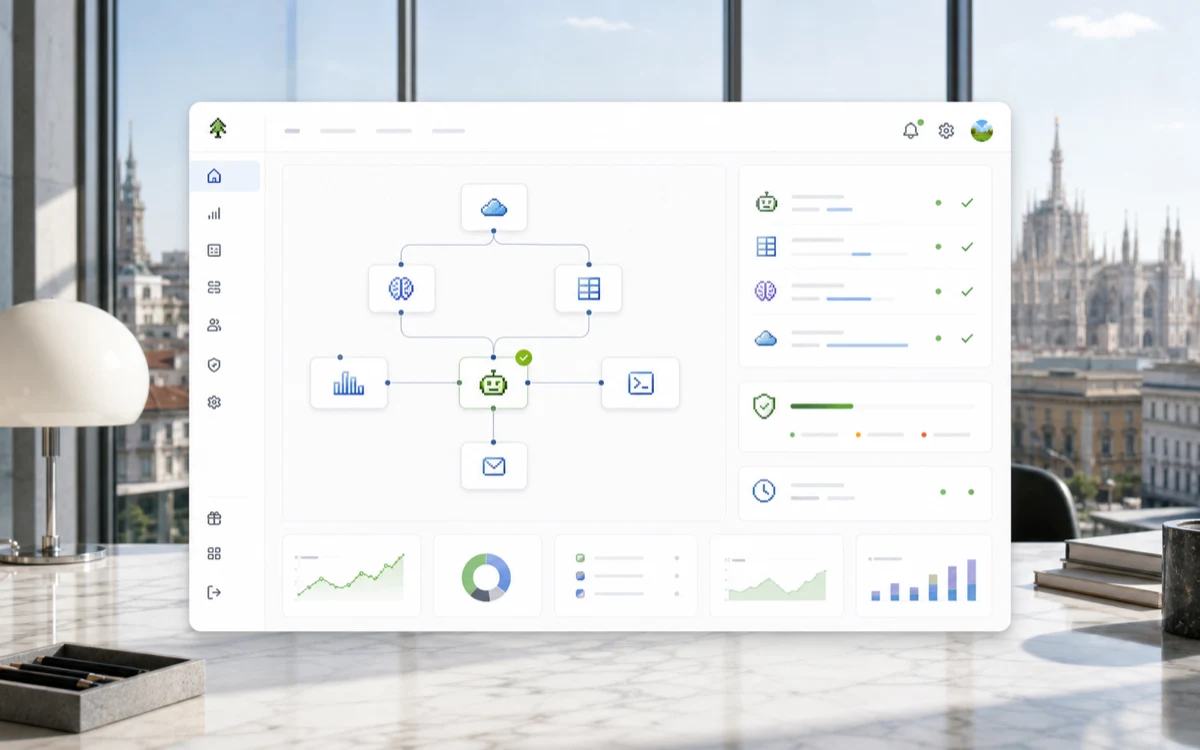
One agent that does a job end to end beats ten generic chatbots.
A generic assistant answers questions. A vertical agent does the work: it reads the document, reconciles the numbers, drafts the memo and files it, inside your systems, with approvals where they matter.
Narrow on purpose
Because it does one job, a vertical agent can be grounded, tested and trusted. It knows the process, the tools and the edge cases, and it knows when to hand off to a person. That's what makes it something a team relies on, not a novelty.
The constraint looks like a sacrifice and is in fact the reason it works. An assistant that could do anything can be verified on nothing: there is no test set for "any question at all". An agent that reconciles one department's supplier invoices has a finite perimeter, and therefore a measurable one: you know what it should do, you know when it gets it wrong, you know what it is worth.
What changes in practice
The distinction isn't a matter of vocabulary. It changes where the software lives and who answers for it:
- A chatbot returns text to a person, who then does the actual work. The task stays entirely on them.
- A vertical agent performs the task inside company systems and returns a result, not a suggestion.
- A chatbot is judged on impression, by reading the answer. An agent is judged on completed work, with a verifiable outcome downstream.
The question that separates the two
If you switched it off tomorrow, would anyone notice within the hour? For a vertical agent the answer is yes, because a task would stop being done. For most generic assistants the answer is no, and that tells you everything about the value they were producing.
Why generic pilots stall
A generic tool doesn't know your company: it doesn't know that one field is read differently for a particular counterparty, that one step requires a signature, that one exception comes back every quarter end. None of this shows in the demo, because the demo uses a clean case. It shows in month three, when the edge cases are forty per cent of the volume and the pilot stops.
Vertical agents avoid that wall because they start from the opposite end: first you watch how the work actually happens in a department, then you build. It is the same reason we send engineers inside the company rather than shipping a tool and wishing you luck.
One narrow agent running in production is worth more than ten capabilities demonstrated once. The first changes how a department works; the others stay a presentation.